Haemorrhoids must be treated promptly, as they threaten the development of serious complications. Drug therapy is often used, but it is not always effective. Therefore, for haemorrhoids treatment a special procedure is used. Ring ligation is a modern and reliable way to remove haemorrhoids in the early stages.
Haemorrhoids and its types
Содержание
Haemorrhoids are a disease that causes an enlargement of haemorrhoids in the rectum. It is characterized by pain and periodic bleeding from the rectum. This condition occurs with equal frequency in women and men.
Haemorrhoids come in several types:
- external;
- internal;
- combined.
Haemorrhoids also have 4 stages of development:
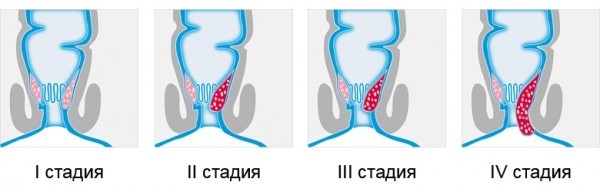
The first stages are characterized by mild clinical symptoms. Haemorrhoids in this case are easier to treat.
At stage 4, haemorrhoids have pronounced clinical symptoms and massive bleeding.
Latex ligation options
Latex ligation of haemorrhoids is a minimally invasive medical procedure performed to treat internal haemorrhoids. The essence of the procedure is to compress the node and place a latex ring.
Due to mechanical impact, blood circulation in this area is disrupted and the node is “removed” on its own.
This procedure is well tolerated by patients and has a short recovery period. But it is prescribed only for internal and uncomplicated haemorrhoids.
Vacuum ligation
Vacuum ligation is a manipulation performed using a vacuum ligator. This is a medical device that retracts the haemorrhoid into a special tip. After which the knot is fixed with a ring.
The use of vacuum ligation is considered the most common procedure in modern proctology.
Mechanical ligation
Mechanical ligation is the removal of haemorrhoids using forceps. During the procedure, tissue is captured using forceps and fixed with a latex ring.
Indications
The main indication for the procedure is haemorrhoids from stages 1 to 3 of their development. Rings for haemorrhoids are indicated for internal and uncomplicated haemorrhoids.
And in severe cases, rings for haemorrhoids are ineffective. Therefore, invasive interventions are carried out.
These include surgical removal of haemorrhoids. This operation is performed under general anesthesia and has a longer recovery period.
Contraindications
Like any medical procedure, ligation of haemorrhoids has a number of contraindications. They can be either temporary or permanent.
The main contraindications include:
- acute inflammatory processes;
- relapses of chronic diseases;
- infectious diseases;
- malignant neoplasms of the intestine;
- severe cardiovascular pathologies (myocardial infarction, heart failure);
- injuries;
- conditions after surgery;
- hematological diseases (poor blood clotting, anemia, leukemia);
- severe liver diseases;
- diabetes mellitus (in severe cases);
- vascular thrombosis;
- intestinal fistulas;
- intestinal bleeding;
- proctitis;
- intestinal polyps;
- anal fissures;
- combined form of haemorrhoids.
Preparation for surgery
Preparation for surgery begins with laboratory tests. This is necessary to assess the patient’s readiness for surgery.
The following studies are being carried out:
- clinical blood test;
- biochemical blood test;
- coagulogram;
- electrocardiography;
- Ultrasound of the abdominal organs;
- anoscopy;
- colonoscopy (if necessary).
The most informative is anoscopy. This procedure involves examining the lower rectum using an endoscopic instrument.
If necessary, consultations with specialist doctors are carried out.
Immediate preparation before ligation begins several days in advance.
It is not recommended to consume foods that cause increased gas formation during this period. These include:
- fresh cabbage;
- beans;
- peas;
- smoked and fried dishes;
- soda;
- flour products.
It is also not recommended to drink alcohol before surgery.
As prescribed by a doctor, all medications except those that are vital are discontinued. This mainly applies to anti-inflammatory and anticoagulants.
Preparation for ligation must be clarified at the clinic in advance. The possibility of eating depends, in particular, on whether sedation or anesthesia is planned; The universal recommendation to have breakfast before surgery is incorrect. Enemas and other methods of preparation are used only according to the doctor’s instructions, taking into account pain, bleeding and related conditions. You cannot stop anticoagulants and other permanent medications on your own.
Technique
The procedure is carried out without anesthesia, but local anesthesia can be performed taking into account the individual characteristics of the patient.
The patient is placed in the side-lying position with the legs adducted to the stomach.
The specialist inserts an anoscope, a special device for monitoring the procedure, into the rectum. Then he applies a ligature.
Then, using a special device, the haemorrhoid is fixed and a latex ring is put on.
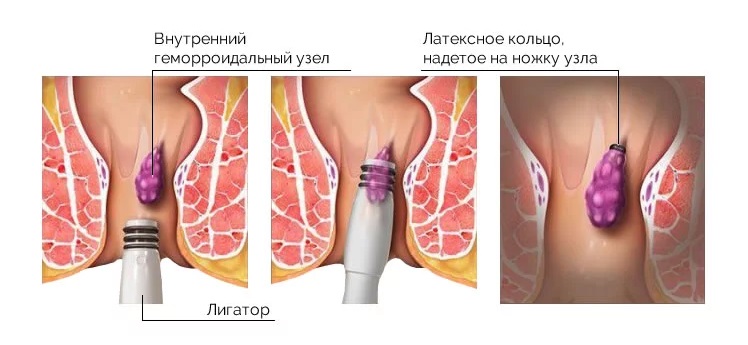
In one procedure, 1 haemorrhoidal node can be fixed, depending on its size. The rest are deleted later. The time frame is set by the doctor, since in order to perform a repeat operation, the degree of healing must be assessed.
During the operation, an experienced proctologist can install 1 to 2 latex rings on the haemorrhoid.
The duration of the operation is from 15 minutes to 1 hour. After which the person can go home.
Fixed haemorrhoids are removed independently during bowel movements over several days.
After surgery, the patient may experience pain in the rectal area, but, as a rule, this discomfort can be relieved with painkillers.
Recovery after surgery
The rehabilitation period takes about 1 month. In the first days after surgery, you should limit any physical activity, do not sit for a long time and do not take a hot bath. Such measures are aimed at preventing anal bleeding.
In the next week, you can gradually introduce adequate physical activity, for example, morning exercises. But at the same time, make sure that there is no excess pressure on the rectal area.
For a month, you must follow the recommendations and also do not lift heavy objects or put stress on the anal area.
It is also recommended to adjust your diet. Products must be mechanically gentle and not cause problems with defecation.
The following should be excluded from the diet:
- fig;
- potatoes;
- white cabbage;
- beans;
- preservation;
- spicy and smoked dishes;
- sweets;
- carbonated drinks;
- strong coffee.
And also during the recovery period you need to give up alcohol.
The diet of patients who have undergone surgery must be balanced and contain all the necessary vitamins and microelements.
It is recommended to eat pureed dishes, cereals, purees and broths in the first days after surgery. Fermented milk products are also recommended to normalize intestinal function.
It is recommended to include in the diet:
- lean meats;
- fish;
- stewed vegetables;
- fermented milk products.
You need to eat fractionally, in small portions, but often. Optimally – 5–6 times a day.
It is also necessary to pay attention to the drinking regime. Drinking enough fluids prevents constipation.
- anti-inflammatory drugs;
- antibacterial drugs;
- painkillers and antispasmodics;
- laxatives in tablet form.
Enemas after surgery are contraindicated, since such a procedure can damage the mucous membrane.
After removal of haemorrhoids, the risk of their re-formation remains, so it is important to undergo a timely examination by a proctologist. The frequency is determined by a specialist.
Possible complications
Despite the fact that the procedure has a low risk of complications, in some cases it is possible. This phenomenon may be due to non-compliance with doctor’s recommendations and other factors.
Possible complications include:
- bleeding;
- latex ring falling out;
- inflammation;
- thrombosis.
If pain increases, bleeding from the rectum and other alarming symptoms, you should consult a doctor.
Any treatment should begin with a consultation with a proctologist. Our medical center employs qualified haemorrhoid doctors who have extensive experience in treating haemorrhoids.
The clinic also conducts diagnostic tests, including anoscopy. It helps evaluate the anal canal and lower rectum. The possibility and tolerability of examination depends on the patient’s condition; in case of severe pain or inflammation, the doctor selects gentle tactics and the necessary pain relief measures.
During the consultation, the doctor will choose the treatment method that is suitable for you. Do not neglect consulting a doctor; at the first symptoms, sign up for a consultation and anoscopy at our medical center. An appointment with a proctologist can be made either by phone or during a personal visit to the clinic.
Also at the Proctology Center there is a service – “proctologist at home”. This allows you to get expert advice without leaving your home.
Questions and answers
Identified medical inaccuracies are clarified in the material. Methods, contraindications and recovery depend on the individual situation; information helps you prepare for the consultation.
ASCRS: Haemorrhoid Recommendations, 2024 · NIDDK: Haemorrhoidal Disease